
Pest Control · Locally Owned in Key Largo
Key Largo to Marathon & South Miami-Dade
Same-day service in the Upper and Middle Keys · 17 years experience
Big Headed Ant
Also known as: Bigheaded Ant, African Big-Headed Ant, Coastal Brown Ant, Brown House-Ant, Lion Ant, Sugar Ant, Pheidole megacephala
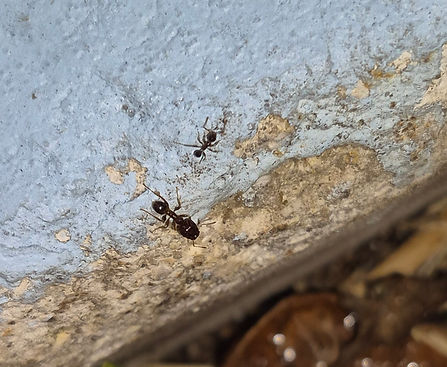
Big-headed ants are the small reddish-brown ants that cover a driveway, a pool deck, or a patio by the thousands and leave little piles of sand along every crack. Most are tiny workers; a few are soldiers with a head out of proportion to the body, which is where the name comes from. They're an invasive species that has taken over large parts of the Keys and South Miami-Dade, and a single supercolony can run across several properties, which is why treating one yard by itself doesn't hold.
They nest in the ground: under pavers, along the slab, at the base of palms, under the sod, and in the sand fill around a seawall. They trail up the walls into the house for sweets and grease, and they farm aphids and scale on the hedges for honeydew.
Signs you have them
Sand or dirt piles along driveway joints, paver edges, the pool deck, and the base of the walls.
Dense ant trails on the outside walls, especially at dusk and after rain.
Fragile, sandy tubes along the foundation that look like termite tubes but crumble at a touch.
Ants in the kitchen or bathroom coming from the window tracks or the slab edge.
Ants swarming the hibiscus, the gumbo limbo, or any plant with aphids.
How we treat big-headed ants
The inspection maps the nest sites around the property, because the colony is in the ground and the ants in the kitchen are just the foragers. Treatment is a non-repellent application to the perimeter, the paver joints, the slab edge, the tree bases, and the nest sites, plus bait in the trails. Because the colony is often larger than your lot, this is a recurring pest; one treatment knocks it down, and a bi-monthly plan keeps it down. We'll tell you honestly what to expect after the inspection.
What you can do in the meantime
Don't spray the trails on the wall. It kills the foragers you see and the colony replaces them in a day.
Keep mulch off the slab and fix any irrigation that keeps the foundation wet.
Treat the aphids and scale on the plants against the house, or let us. That's their food supply.
Talk to the neighbor. If their yard is the source, treating both sides works far better.
Big-headed ant FAQ
Are these fire ants? No. Fire ants build raised mounds and sting. Big-headed ants leave flat sand piles and bite, but it's mild. Fire ants are rarer in the Keys than on the mainland.
Why do they keep coming back? Because the colony extends past your property line. Regular service and treating the nest sites, not just the trails, is what keeps them out.
Are those mud tubes? Big-headed ants build loose, sandy tubes that fall apart when touched.